
0:16:32
-
浅谈高素质创新型人才的软实力与巧实力(4)
- 首届重庆青年材料科学技术研讨会——本片由中国工程院院士、四川大学博导涂铭旌教授介绍新时代大变革大挑战、科技竞争硬与软实力的思考、高素质创新型人才的培养和人才软实力培养的实践与探索等内容。
- Keyword:创新型人才 软实力 科技竞争能力 巧实力

0:14:55
-
非磁有机半导体器件中的奇特磁效应(1)
- 首届重庆青年材料科学技术研讨会——本片由西南大学物理科学与技术学院院长熊祖洪教授介绍有机发光简介、有机磁效应的研究进展和奇特磁效应的科学问题等内容。
- Keyword:有机半导体 巨磁现象 有机磁效应 奇特磁效应
0:23:06
-
非磁有机半导体器件中的奇特磁效应(2)
- 首届重庆青年材料科学技术研讨会——本片由西南大学物理科学与技术学院院长熊祖洪教授介绍有机发光简介、有机磁效应的研究进展和奇特磁效应的科学问题等内容。
- Keyword:有机半导体 巨磁现象 有机磁效应 奇特磁效应

0:18:04
-
非磁有机半导体器件中的奇特磁效应(3)
- 首届重庆青年材料科学技术研讨会——本片由西南大学物理科学与技术学院院长熊祖洪教授介绍有机发光简介、有机磁效应的研究进展和奇特磁效应的科学问题等内容。
- Keyword:有机半导体 巨磁现象 有机磁效应 奇特磁效应

0:25:30
-
线式温度传感器的回顾与展望
- 首届重庆青年材料科学技术研讨会——本片由重庆材料研究院有限公司赵彦教授介绍线式温度传感器的背景、结构、原理、应用领域以及当前技术发展趋势等内容。
- Keyword:线式温度传感器 市场前景 前沿技术
0:18:24
-
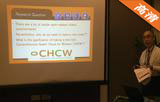
A New Approach to Assess Work Stress-related Ill-health(1)
- 2014 Conference on Psychology and Social Harmony (CPSH 2014)——According to the biopsychosocial-existential model of mental health, workers’ response to stressors may reflect largely their distorted daily life activities. In this perspective, I and co-workers have recently developed the “Comprehensive Health Check for Workers (CHCW)” questionnaire which can asses comprehensively at-risk workers’ pre-symptoms of mental and physical disorders at the subclinical stage, and so may prevent work stress-related diseases, particularly depression.
- Keyword:工作疾病 综合健康检查 工作压力 抑郁症 心理健康

0:15:56
-
A New Approach to Assess Work Stress-related Ill-health(2)
- 2014 Conference on Psychology and Social Harmony (CPSH 2014)——According to the biopsychosocial-existential model of mental health, workers’ response to stressors may reflect largely their distorted daily life activities. In this perspective, I and co-workers have recently developed the “Comprehensive Health Check for Workers (CHCW)” questionnaire which can asses comprehensively at-risk workers’ pre-symptoms of mental and physical disorders at the subclinical stage, and so may prevent work stress-related diseases, particularly depression.
- Keyword:工作疾病 综合健康检查 工作压力 抑郁症 心理健康
0:11:12
-
Can Political Orientations Be perceived from Faces(1)
- 2014 Conference on Psychology and Social Harmony (CPSH 2014)——I attempt to understand what perceptual heuristics are used for judging political identities from faces. This question was explored in a study which measured eight perceived facial features that are either about emotional expressions or related to personalities in addition to the perceived political affiliation of the target faces. Participants were also assessed on their political leaning and political knowledge. There are two major conclusions emerging from the analysis. First, the perception of democrat vs. republican faces is mainly driven by two factors----the affect factor, or how emotionally positive a face appears to be, and power factor, or how dominant and mature a face appears to be.
- Keyword:政治倾向 政治身份 情绪 面部特征 情感表达
0:16:51
-
Can Political Orientations Be perceived from Faces(2)
- 2014 Conference on Psychology and Social Harmony (CPSH 2014)——I attempt to understand what perceptual heuristics are used for judging political identities from faces. This question was explored in a study which measured eight perceived facial features that are either about emotional expressions or related to personalities in addition to the perceived political affiliation of the target faces. Participants were also assessed on their political leaning and political knowledge. There are two major conclusions emerging from the analysis. First, the perception of democrat vs. republican faces is mainly driven by two factors----the affect factor, or how emotionally positive a face appears to be, and power factor, or how dominant and mature a face appears to be.
- Keyword:政治倾向 政治身份 情绪 面部特征 情感表达
0:15:11
-
Neural Network Analysis of Nonlinear Effects of Hardiness on Burnout in Chinese Nurses
- 2014 Conference on Psychology and Social Harmony (CPSH 2014)——Substantial research attention is evident in the hardiness and related literature concerning the topic of moderation effects of hardiness on work-related stressors and strains. In this research mostly linear methods have been used to analyze these moderating effects. However, it is not very likely that these effects are purely linear. The present study uses a neural network, a method which can model nonlinear relationships, to analyze the effects of hardiness. A cluster analysis of 268 Chinese nurses based on their self-ratings in the hardiness dimensions of commitment, challenge, and control was performed. Two groups of individuals were identified, consisting of (1) those who scored above average and (2), those who scored below average on all hardiness dimensions. On the basis of these clusters, a multi-layer neural network was used to analyze the data.
- Keyword:神经网络分析 耐劳性 中国护士 工作压力